The State Still Does Not Directly Fund Full-Day Pre-K
HB 3 (2019) required districts to offer a full day of pre-K instruction to eligible four-year-olds, but formula funding stayed at the half-day rate. Districts were provided additional funding, known as the Early Learning Allotment, but this funding was insufficient to cover all required expenses, including full-day pre-k, reading academy training for all K-3 teachers, and high dosage tutoring programs. Districts had to cover the difference using grants, federal Title I dollars, and local funds redirected from other needs.
The 2025 session’s major school-finance bill, HB 2, changed how the Early Education Allotment is distributed among districts to encourage districts to apply the funds to full-day prekindergarten, but it did not correct the underlying half-day formula. Funding for three-year-olds remains at ½ day with no additional funding to expand to full-day. For this reason, few San Antonio area districts offer pre-k to three-year-olds outside of Head Start classrooms.
State Eligibility Remains Narrow
Public schools are permitted to serve only a portion of prekindergarten students. Eligibility categories are limited to income below 185% of the federal poverty guidelines, homelessness, foster care, emergent bilingual status, active-duty or killed in action military, Star of Texas Award, and children of classroom teachers. By design, Pre-K 4 SA is open to any three- or four-year-old in San Antonio with priority given to low- and middle-income, military connected, homeless, and children in foster care.
Eligibility Category | Pre-K 4 SA | Public School Districts |
|---|---|---|
Low income (<185% FPL/ ≈57% SMI) | ✓ | ✓ |
Middle income (186-220% FPL/ 85% SMI) | ✓ | — |
Active-duty military | ✓ | ✓ |
Military veterans | ✓ | — |
Military reserve | ✓ | — |
Child of armed forces member
killed in action | ✓ | ✓ |
Homeless | ✓ | ✓ |
Foster care | ✓ | ✓ |
Emergent bilingual | ✓ | ✓ |
Children of teachers | ✓ | ✓ |
Children of Star of Texas
Award recipients | ✓ | ✓ |
Children with exceptional needs | ✓ | — |
4-year-olds, full day | ✓ | ✓ |
3-year-olds, full day | ✓ | Half Day Only |
HB 2 (2025) Tightened Districts’ Ability to Serve Beyond State Eligibility
Before HB 2, districts with open seats could offer tuition-based pre-K to families outside the state’s free-eligibility. This had the unintended consequence of destabilizing private child care for children under the age of three. To correct this, HB 2 narrowed school districts’ ability to serve children beyond those who are eligible for free public pre-kindergarten.
Starting in the 2027–2028 school year, a district may only offer tuition-based pre-K if one of the state’s newly designated intermediary organizations first confirms that no eligible private child care provider is available to serve the child. The same new intermediary sign-off is now required before a district can build or repurpose a classroom to serve pre-k students at all.
Texas Currently Does Not Require Quality in Pre-K
The National Institute for Early Education Research (NIEER) tracks ten minimum quality benchmarks for state pre-K programs nationally. Texas met four of the ten as recently as the 2022–2023 school year; after the Legislature loosened teacher-credential requirements in 2023 (HB 2729, allowing associate degrees in place of a bachelor’s degree), Texas dropped to just two of ten benchmarks in 2024. NIEER also ranks Texas 40th nationally in per-child pre-K spending.
Conversely, Pre-K 4 SA was built with high-quality at its core. Pre-K 4 SA Education Centers are NAEYC accredited and meet all 10 NIEER benchmarks. Additionally, external evaluations consistently demonstrate that Pre-K 4 SA delivers exceptionally high-quality early education that results in children being more than kinder ready.
Pre-K 4 SA Kindergarten Readiness 1
Source: Westat (2026). Pre-K 4 SA Education Centers: Year 12 (2024-2025) Evaluation Brief
Only 20% of Eligible 3-Year-Olds are Being Served
When Pre-K 4 SA launched in 2013, only 46.8% of eligible four-year-olds in San Antonio enrolled in public prekindergarten. By 2018, enrollment increased to 61.3%, far outpacing other urban areas in Texas. A study by the Urban Education Institute in Texas attributed this rapid rise to the presence of Pre-K 4 SA.
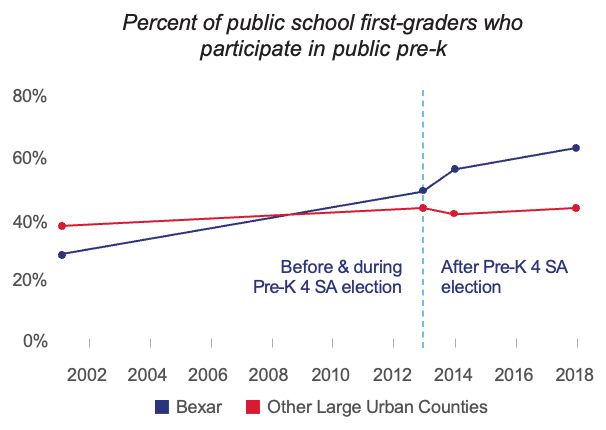
Source: Villarreal, M.U. (2019) Impact Study of Prekindergarten for San Antonio (2019). Urban Education Institute at UTSA.
By 2022, 90% of eligible four-year-olds in San Antonio were enrolled in prekindergarten. For three-year-olds, the story was very different. Only 12% of eligible three-year-olds were enrolled in public pre-K, largely because so few school districts offered prekindergarten to three-year-olds. Low-income families who wanted an alternative faced another barrier; the waiting list for a child care scholarship that would let them enroll in a participating private child care center numbered in the thousands, leaving most families with few real options.
Pre-K 4 SA began admitting three-year-olds in 2023 to help close that gap. By the 2024-25 school year, three-year-old enrollment in public prekindergarten had risen to 20%, an increase driven almost entirely by the roughly 1,000 three-year-olds Pre-K 4 SA serves each year. Pre-K 4 SA remains committed to expanding access by working through partnerships with school districts and high-quality child care providers to reach more three-year-olds.
Early Learning is Far More than Prekindergarten
While enrollment in prekindergarten is important, early learning is much more than a single year of classroom instruction before kindergarten. It is the accumulation of experiences, relationships, and skill-building that begins at birth, long before any child is old enough to qualify for a pre-K seat. An estimated 90% of a child’s brain growth happens before age five. Foundational skills such as language, self-regulation, early literacy and numeracy are already taking shape in infancy and toddlerhood. By the time a child walks into a prekindergarten classroom, three to four years of the most critical developmental window have already passed, largely outside the reach of any coordinated public system.
Neither the private market nor state policy has closed the structural gap in early learning. What makes San Antonio a national leader in early learning is we did not wait for state policy or the market to catch up with brain research. The visionary Brainpower Task Force designed Pre-K 4 SA to address the full early learning age span, not just the single year the state funds. That design shows up in how the program operates: infant and toddler classrooms at its newest campus, citywide coaching and quality-certification support for nearly 100 independent child care providers serving children well below pre-K age, and professional development open to early learning educators across San Antonio, regardless of what age group they teach. Where state law treats early education as a single grade level, San Antonio built a program around the idea that birth to five is one continuous developmental period and that a city serious about school and career readiness has to invest in all of it, not just the year immediately before kindergarten.