
Your outdoor space offers a world of learning experiences your children will enjoy.
Continue reading
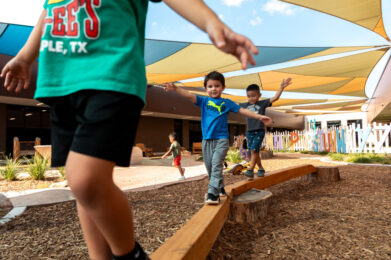
Follow along to see the critical thinking skills and active learning built into each step of the day.
Your outdoor space offers a world of learning experiences your children will enjoy.
Continue reading
Over the past 30 years, creativity and the arts have been systematically removed from the core K-12 education system.
However, according to the Wolf Trap Institute for Early Learning through the Arts, “integrating the performing arts into early childhood education is a highly effective way for young children to learn and for early childhood educators to teach.”
The Wolf Trap Institute for Early Learning is a program developed by the Wolf Trap Foundation and is funded by a major grant from the U.S. Department of Education. It uses art-based techniques to improve the foundation for all sciences, technology, engineering, and math (STEM).
In 2016, theArtsFund became an affiliate of the Wolf Trap Institute for Early Learning. That same year, Pre-K 4 SA became a partner and hosted 10 artist residencies and training sessions. Residencies are defined time periods during which artists from an array of arts backgrounds use their artistic fortes to provide teachers with creative tools to incorporate the arts into their curriculum. Pre-K 4 SA quickly began to implement these learning models into the classroom, which resonated well with its “learn through play” curriculum.
A new Wolf Trap pilot program will begin at Pre-K 4 SA in February 2020 and will last for a total of eight weeks. The pilot program will focus on the following growths: reflection time for staff and resident artists, variety in the techniques used, and teacher support upon the completion of the residency.
Jessica Ambris, a Pre-K 4 SA teacher and Dr. Aurelia Rocha, a San Antonio Wolf Trap teaching artist, have been collaborating and refining the Wolf Trap program at Pre-K 4 SA for the past six months. Together they recognized that a vital aspect of the program should create a culture of professional dialogue and collegiality around new ideas and prior experience.
Since Wolf Trap has residencies from all artistic backgrounds, the teaching techniques will likely differ according to the artist’s talent. For example, a dancer will use dance and body movements to help children understand a concept, while a musician will use an instrument and music to teach children. With that in mind, there is much depth and versatility to using the arts in the classrooms.
“As a teacher, I’ve learned from one of our drama residencies and applied some of the techniques in my own instruction. My class was interested in learning the difference between frogs and toads. Using the imaginary costume closet, I remember the children were engaged as they acted out as if they were changing into either a frog or a toad,” said Ambris. “They would pretend to become their character by imagining specific traits such as smooth or bumpy skin. By using their imagination, children were able to apply what they had learned and really understand the differences between the two.”
Prior to this new pilot program, only one resident artist was assigned to one teacher and his or her classroom. Now, one resident artist will be in one classroom but teaching a cohort of five teachers. The training will last for nine weeks with a total of 21 sessions. Thereafter, there will be a 75-minute reflection time which will give time for teachers and resident artists to discuss and plan for the week. Then teachers will go into their own classrooms and implement the Wolf Trap strategies they are acquiring on a weekly basis.
Each week, all participating teachers will have the opportunity to share what is working for them and at the same time, share what has not been effective. As teachers come together and build this commonality, they will share ideas to build their artistic skills to deliver the lesson to their classrooms.
Using the arts to teach a curriculum should always be engaging and fluid. This new Wolf Trap pilot program will continue to help children use all of their senses to better learn the curriculum. Once the first Wolf Trap pilot program is complete and evaluated at the South Education Center, it will be duplicated into the other Pre-K 4 SA Education Centers.

Since its inception in 2013, our vision of Pre-K 4 SA has been to develop a world-class workforce through high-quality early childhood education in one generation.
To make this vision a reality, we needed to go beyond the traditional Pre-K curriculum that prepares our children for Kindergarten and concentrate more on preparing them for life. By including a focus on the development of executive function skills, we are preparing our children for success, beyond the preschool classroom to the executive board room and everywhere in between.
Executive functions are a set of cognitive processes or neurologically-based skills (i.e., mental control and self-regulation) that are necessary to perform functions that help us reach our goals.
Executive functions are sometimes referred to as the “air traffic controllers” of the brain. They take in and analyze the incoming data, filter out distractions and allow us to respond in the most effective, appropriate manner.
Many scientists and educators have developed their own working definitions and lists of key executive functions. The three most commonly discussed executive functions include working memory, inhibitory control which includes self-regulation, and cognitive flexibility.
Using the HighScope curriculum, teachers at Pre-K 4 SA also facilitate the development of initiative, emotional control, planning, organization, problem solving, and self-monitoring or evaluating.
Working Memory – This is the ability to hold information long enough to accomplish the task at hand, like following directions, staying focused during small group, or making a plan and following through with it.
Inhibitory Control – This involves the ability to stop a behavior or postpone it until a more appropriate time. For young children, this includes running to get something they want when running is not appropriate in the setting, grabbing an object from another child, or shouting out answers or inappropriate comments.
Cognitive Flexibility – This is sometimes referred to as “shift” because we need to be able to quickly shift from one focus to another and back again without totally breaking our concentration.
Initiative – Children need to be able to take initiative and begin projects, complete tasks on their own and express their own ideas.
Emotional Control – Children should be taught that all emotions are okay to experience and that there are socially acceptable ways of expressing them.
Planning – Children are taught to create and carry out a plan for their work time every day. As the school year progresses, the plans become more detailed and elaborate.
Organization – The classroom is set up for children to encourage independence. All materials and shelves are labeled so children can keep the room neat and tidy. Materials are also arranged by function to help children see how different objects can have a common use or purpose.
Problem Solving – Problem solving can be viewed in two ways. Children can solve problems with materials. They need to be persistent and feel safe in taking risks by trying multiple solutions and thinking outside that proverbial box. The other type of problem solving is with another child. Often the problem involves an object that both children want at the same time. We use six steps of conflict resolution to help the children identify the problem and come up with a solution both parties agree will solve it.
Self-Monitoring – Of course there are multiple opportunities throughout a typical day for children to quickly reflect on a decision, action or piece of work, but HighScope curricula creates dedicated times in daily schedules for such reflection. After children make and carry out their daily plan, they are given the opportunity to reflect on how closely they followed their plan (what worked and what didn’t work), if they changed their plan altogether, and why.
We know people are not born with the skills, but the ability to develop them. Therefore, we take advantage of every opportunity to set the foundation upon which our children can build. Pre-K 4 SA recognizes the importance of these executive function skills to be successful throughout life.
Written by: Erin Burnett, assistant director of Curriculum and Instruction

It was not too long ago that social and emotional learning (SEL) in pre-k was thought of as sharing, playing nicely with others, and doing what your teacher asked. While these skills are definitely part of SEL, they are only the very basics of what we know to be foundational skills that impact cognition, academic learning, relationships and wellness.
Very often we think of development as occurring in isolated categories, with developmental milestones in areas such as language, cognition, and social and emotional skills being associated with specific ages. In truth, you really can’t separate them. They occur simultaneously and impact each other along the way.
The brain of a child during the early childhood years is undergoing such rapid development that it’s crucial educators address SEL in the same manner they address language and literacy, with research-based curriculum and dedication to effective teaching strategies.
The Collaborative for Academic, Social and Emotional and Learning (CASEL) defines SEL as “the process by which individuals acquire and apply knowledge and skills necessary to understand and manage emotions, feel and show empathy for others, set and achieve goals, form relationships, and make responsible decisions.” Social and emotional learning skills include five core competencies: self-awareness, self-management, social awareness, relationship skills and responsible decision making.
The outcomes associated with well-developed social and emotional skills are significant. School-age children have better academic performance and reduced disciplinary issues. Long-term outcomes include an increased likelihood of having healthy relationships, good mental health and stable employment. Meanwhile, there is a decreased likelihood of using drugs and being incarcerated. Studies have shown that employers specify competencies directly associated with social and emotional skills as critical in a highly-skilled 21st century workforce.
At Pre-K 4 SA, social and emotional learning is embedded in our HighScope curriculum. HighScope’s approach to teaching SEL is through effective teacher instructional practices that include positive adult-child interactions, and emphasize active participatory learning, regular routines and attention to an optimal learning environment. Children learn conflict resolution skills in the classroom as they navigate what is often their first classroom experience.
Pre-K 4 SA’s Social and Emotional Learning Team, comprised of behavior specialists and a licensed specialist in school psychology, supports SEL for all children and works to promote accessibility and meaningful inclusion for children with special needs. The SEL Team maintains a strong focus on helping children develop self-regulation skills that are crucial to building other SEL competencies such as relationship skills and responsible decision making. When children are able to self-regulate, they are better able to focus their attention, respond appropriately when upset, and learn new material. This contributes to a reduced need for more restrictive educational settings.
One of the most important aspects of solid social and emotional learning is parent involvement. Parents and caregivers are the experts on their child, as they know their child best. They provide teachers with valuable information that allows the school team to work together with them for best results. This coordinated effort between school, families and communities is what ensures success.
Written by: Maria Bayoumi, Pre-K 4 SA’s licensed specialist in school psychology

For many families, there may be an endless struggle at the dinner table to have children eat all of their fruits and vegetables.
However, Pre-K 4 SA is trying to change the evening argument by showing young children the importance of nutrition by having them grow fruits, vegetables and herbs in their very own garden.
For many years, Pre-K 4 SA has had gardens for its classes. However, last year, a Garden to Table program created by CHEF: Culinary, Health, Education for Families (CHEF) was introduced into Pre-K 4 SA’s curriculum. In this program, all classrooms are assigned a garden in their outdoor learning areas. Here, they plant seeds, then water, weed, and nurture their gardens until the students see the bounty of their efforts as the fruits, herbs, and vegetables sprout.
This academic year, the CHEF program was modified to meet Pre-K 4 SA’s high-quality standards and introduced to teachers. As of October, teachers are teaching basic nutrition and practical cooking skills to encourage healthy eating routines. Additionally, CHEF is collaborating with the San Antonio Food Bank in teaching the importance of nutrition to San Antonio’s youngest learners at Pre-K 4 SA.
“Health and nutrition have become an integral part of my life and sharing what I’ve learned has become my goal,” said Julie Taylor, CHEF instructional specialist. “CHEF has allowed me to bring knowledge to young children through hands-on, meaningful activities that teach basic nutrition and practical cooking skills.
CHEF’s mission is “rooted in the belief that food is medicine.” The organization’s ultimate goal is to motivate individuals and communities to adopt and sustain healthier eating habits.
In San Antonio, CHEF is known through its collaborations with the Children’s Hospital to educate and heal patients and families. CHEF actively trains and certifies healthcare providers in culinary medicine and performs clinical research to measure the efficacy of the CHEF protocol in an acute care setting. Representatives also teach nutrition in after school programs throughout the community.
Every month, a teacher from each classroom will choose a time, day and recipe for his or her class to prepare. In small groups of 10 students, the children will create a recipe by picking their ingredients from their gardens. Classroom-grown fruits, herbs and vegetables will be washed and prepared for recipes. Ingredients not on hand will be ordered from the San Antonio Food Bank.
One of the children’s favorite recipes is “confetti corn,” which has a variety of colorful vegetables such as cooked corn kernels, poblano peppers, carrots, green onions, and cilantro. To better guide the children in understanding the recipe, they are provided a recipe with pictures to help them distinguish between the vegetables.
Once the vegetables have been washed, teachers show their students how to properly hold and use their kid-safe knives and cutting boards for the cutting process. The children begin to carefully cut, cube and dice as they prepare their ingredients for the recipe at hand.
As part of high-quality standards, throughout the 20 to 30 minutes of building a recipe, teachers encourage students to assist their families in cooking at home. Children learn more about the five food groups and the importance of balanced meals and healthy food portions.
Teachers take the time to engage with the students and discuss their experience using new utensils, different tastes and textures of each ingredient, and the combined taste of ingredients. Teachers are encouraged to use culinary terms to help students expand their knowledge of nutrition.
As part of the CHEF program, parents are encouraged to volunteer in their child’s class to assist teachers and students. The added support by parents encourages them to learn more about nutrition and see firsthand what ingredients and recipes their children enjoy.
Children begin to understand that with practice, cooking becomes more fun. Recipes are seen as guidelines for creative and delicious meals. Pre-K 4 SA is happy to fully incorporate the CHEF program to instill balanced nutrition at a young age.
The CHEF program encompasses much more than just ingredients in recipes. As part of Pre-K 4 SA and its core curricular innovations, 4-year-olds are able to refine their motor skills and develop a new vocabulary that promotes stronger health outcomes for the child’s future.

Many tend to associate the arts with Picasso paintings or Shakespearean plays. However, many don’t realize how impactful the arts can be in early childhood education.
On Tuesday, September 3, 2019, Dr. Sarah Baray, CEO of Pre-K 4 SA, and Dr. Kimberly Stephenson, director of education for The Tobin Center for the Performing Arts, discussed “The ‘A’ in STEAM: The role arts integration plays in San Antonio’s classrooms, community, and corporate culture.” Baray explained how Pre-K 4 SA integrates the arts into its curriculum.
During her presentation, there was an overview of the complexity of a child’s brain architecture. Children are born with endless possibilities, and their brains are prewired to allow them to learn anything. Children are capable of speaking any language or multiple languages, developing musical talents, or being facile with numbers.
“Over 90% of brain development occurs before the age of five,” said Baray. “This means that the way our brains will be structured for the rest of our lives is determined at a very early age.”
From the moment a child is born, his or her brain begins to strengthen some of those wires and eliminate others. Those pathways that are frequently stimulated through experiences and interactions get reinforced, while other paths that are seldom used will diminish.
For example, although children are born with the ability to speak any language, they initially learn only those languages that are spoken to them in their households. If children learn multiple languages early in life, it becomes easier for them to learn additional languages later in life because their brain already has strong pathways to support multilingualism. If children grow up only speaking one language, it’s more difficult to learn another language later in life because the brain is trying to build a new pathway when development is slower.
The human brain continues to develop until death. However, the rate of development slows down significantly as people continue to age. In the first five years of life, the brain makes one million neuronal connections every second. Thereafter, from the ages of six to 20, brain development slows down moderately and continues to do so throughout life.
“After the age of 20, our brain development happens at a snail’s pace in comparison to what happens in our early years,” said Baray. “We can still develop new pathways but it takes longer.”
The arts are essential to high-quality early learning not only because we want children to develop the brain architecture to support artistic talents and interests, but also because art is a language and a mode of expression.
Interestingly, art integration is not the norm in most schools today. Over the past 30 years, creativity and the arts have been removed from the K-12 education system. The arts have become an optional aspect and because they’ve been marginalized for the last two decades, children are losing their innovational edge.
For this reason, art integration is a critical tenet of the Pre-K 4 SA approach to high-quality early learning and forms part of one out of the four core curricular pillars. Pre-K 4 SA incorporates the Wolf Trap model into every classroom by inviting local artists to work with the children in creating original works of art.
Another way Pre-K 4 SA incorporates art into its curriculum is through their Gracias San Antonio: Children Are Citizens Project. The project begins in November with the children’s participation in a program-wide election to vote on a local non-profit to support for the academic year. Throughout the year, children and families engage in City Explorations with Pre-K 4 SA teachers by visiting different places around San Antonio as inspiration for pieces of art.
Pre-K 4 SA invites local artists to assist classrooms with the creation of authentic art pieces that express the children’s perspective of the city. More than 100 pieces of art are created and displayed in a public gallery to be auctioned to raise money for the local non-profit organization. Many who attend the annual Gracias showcase are amazed to see the wonderful pieces created by the minds and imaginations of young children.
Pre-K 4 SA strongly believes that by engaging students in art experiences at a young age, children more deeply develop their thinking and creativity, learning to express themselves in a variety of ways.

For some parents, the search for a Child Development Center (CDC) begins shortly after they learn they are expecting. Parents want to give their children the best start in life and that includes providing their children with the best early childhood education available. However, there are factors which can impede them from finding a high-quality center for their child.
The State of Texas has implemented a quality improvement rating system for CDCs, the Texas Rising Star (TRS). According to the TRS website, this program is “a voluntary, quality-based child care rating system of child care providers participating in the Texas Workforce Commission’s subsidized child care program.”
TRS is a quality rating tool which includes three levels of quality: 2-star, 3-star, and 4-star, with 4-stars being the highest level of TRS certification. CDCs are limited within our city, and many have long waitlists; therefore, parents often opt for a closer, uncertified center for the first years of their child’s life.
Currently, 89% of CDCs are not certified in San Antonio. Family-owned, corporate, and faith-based CDCs need support to provide a high-quality education that each child deserves.
The minimum benchmark for child care centers is through the Texas Health and Human Services Minimum Standards for Child Care Centers.
“Centers need to adhere to all minimum licensing standards,” said Janet Henry, professional learning specialist with Pre-K 4 SA. “However, they often have too many deficiencies or critical deficiencies which prevent them from becoming TRS certified.”
In 2016, Pre-K 4 SA saw the need to support CDCs in San Antonio to increase the quality of the centers. Pre-K 4 SA responded by creating a grants program that included CDCs. In its first year, 13 centers were chosen to receive funding through a competitive grants program after responding to a request for proposal for the academic years of 2016-18. The second group of nine centers was recently chosen to receive funding for the 2019-21 academic years, with a new requirement that the centers must be nationally accredited or TRS certified.
In early 2019, Pre-K 4 SA also began a Continuous Quality Improvement (CQI) Cohort, specifically targeting centers throughout the city that would like to become TRS certified. Directors attended monthly meetings to understand and apply the standards at their sites. Funding was provided to several of the centers to assist them in pursuing TRS certification. A new cohort of interested participants began in September 2019.
Northwood Presbyterian Day School is a participant and awardee of the CQI Cohort and Request for Proposals. After an intensive application and interview process, the center began receiving its grant in July 2018. Shortly after, Janet Henry became its professional learning mentor to start preparing the center for the TRS assessment.
Pre-K 4 SA determines the necessities of each center by using an internal High-Quality Impact Pyramid Tool. This pyramid is compared to a nutritional pyramid where the vital, high-quality, foundational practices are located at the bottom, and they are referred to as tiers. Tier 1 is Program Features and Staff Qualifications and starts allocating grant funds in this area. Tier 2 consists of Instructional Quality and Physical Learning Environments. Tier 3 involves Family Engagement and Outreach, and finally, Tier 4 brings Innovation.
As the centers progress, the High-Quality Impact Pyramid Tool allows them to be considered to receive assistance in the higher tiers, and gives them the opportunity to raise their center’s overall quality.
For the past year, Northwood Presbyterian Day School has made modifications and has developed new practices. Frog Street was adopted as the center’s formal curriculum. While the majority of the funds was used to remodel the school’s current playground into an outdoor learning classroom, the grant funds also made it possible to purchase furnishings, chairs, tables, manipulatives, and multilingual publications.
“Janet Henry was very open and receptive to the staff here at Northwood,” said Director of Northwood Presbyterian Day School, Rebecca Cranfill. “She was a very great mentor and leader who brought in a lot of new ideas and excitement. She also allowed us to give our feedback and to grow along in the process.”
The grant program requires administration, teachers and staff to attend 30 hours of best practices for early childhood over a span of one year. Cranfill recalls speaking with teachers after returning from their monthly trainings.
“Our teachers were enthused and ready to start implementing new practices in the classroom immediately,” added Cranfill.
After the long hours of hard work, Northwood Presbyterian Day School received a 4-star rating on June 20, 2019, following its initial TRS assessment.
“If any center in San Antonio has a true passion for children’s education or wants to build a high-quality center, the support provided by Pre-K 4 SA is unparalleled,” Cranfill said. “It was such a blessing for us. By receiving the grant, we were able to accomplish some of those things for which we previously didn’t have funding.”
Currently, Pre-K 4 SA is assisting over 20 centers throughout the city become nationally accredited or TRS certified, and is currently recruiting additional centers.